Medicaid Work Requirements Checker
Do the 2027 Medicaid work rules apply to you, and do you meet them?
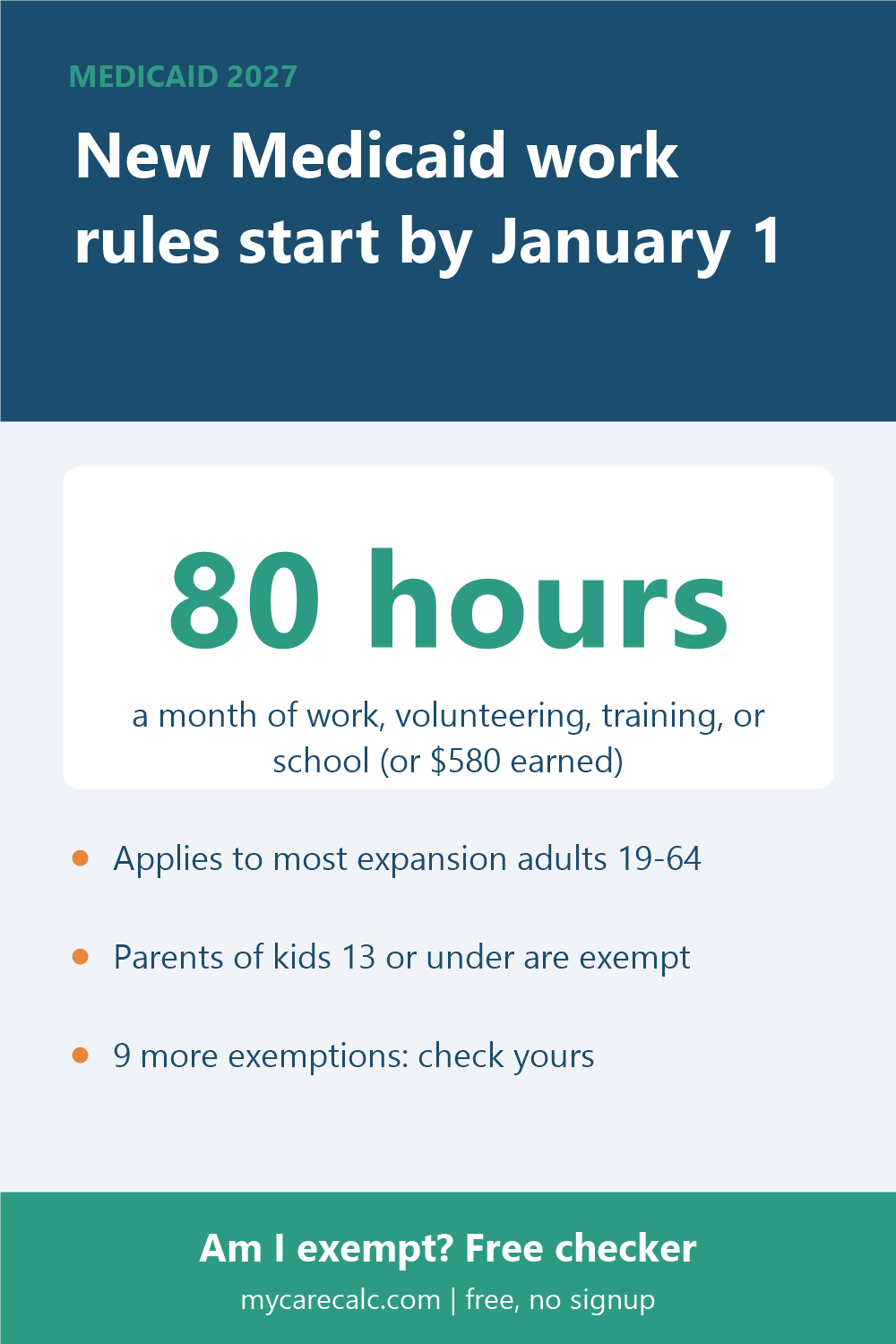
Starting no later than January 1, 2027, adults ages 19 to 64 covered through Medicaid expansion must show 80 hours a month of work, volunteering, job training, or school, unless they are exempt. Answer a few questions to see where you stand. Nothing you enter is saved or sent anywhere.
All jobs, including self-employment
$580+ a month counts instead of hours
You have 0 qualifying hours a month: 80 short of 80. Or, you would need $580 more in monthly earnings to reach $580. Volunteer hours, job training, and half-time school all count and can be combined with work. If an exemption applies to you, check it above. If you get a notice of noncompliance, you have 30 days to respond before coverage can end.
Disclaimer: This calculator provides estimates for educational and informational purposes only. It does not constitute tax, legal, financial, or medical advice. Results depend on individual circumstances and may not reflect your actual costs. Always consult a qualified professional (CPA, licensed insurance agent, or financial advisor) for decisions about your specific situation. Data reflects approximate 2026 figures from IRS, CMS, and HHS sources.
Updated November 12, 2026
What Is Changing in 2027
For the first time nationwide, many adults on Medicaid will have to show they work, volunteer, train, or study for at least 80 hours a month to keep their coverage. The rule comes from the federal budget law passed in July 2025, and states must have it running by January 1, 2027. It applies to adults ages 19 to 64 who qualify through Medicaid expansion, the group covered in most states up to 138% of the poverty level (about $22,025 a year for one person in 2026).
| When | What happens |
|---|---|
| July 4, 2025 | Federal budget law (Public Law 119-21) creates the Medicaid community engagement requirement. |
| June 2026 | CMS publishes the interim final rule states must follow (effective July 31, 2026). |
| Fall 2026 | States send notices to enrollees; some begin collecting information early. |
| By January 1, 2027 | States must start enforcing the requirement (extensions to 2028 possible with a good-faith exemption). |
| 2027 renewals | Expansion adults move to six-month renewals, with work or exemption checks at each one. |
How to Meet the 80-Hour Requirement
Any one of these counts for a month:
- 80 hours of paid work, community service or volunteering, a work program, or job training, in any combination (for example, 50 hours of work plus 30 hours of volunteering).
- School at least half time, such as a community college or a vocational program.
- Earnings of at least $580 a month, which is 80 hours at the $7.25 federal minimum wage, even if you worked fewer hours. Seasonal workers can generally average their income over several months.
Worked examples
- Maria, 34, works 25 hours a week at $14 an hour: about 108 hours and $1,512 a month. She meets the requirement two ways.
- James, 41, does gig work for about 60 hours a month earning $900: he is short on hours, but his earnings are above $580, so he meets the income alternative.
- Dana, 29, is not working and has a 6-year-old: as the parent of a child 13 or younger, she is exempt.
- Luis, 52, works 40 hours a month and has no exemption: he needs 40 more hours, for example by volunteering at a food bank or enrolling in a job training program.
Who Is Exempt
You do not have to meet the hours if you are pregnant or postpartum; a parent or caretaker of a child 13 or younger or of someone with a disability; medically frail (including people with disabilities, serious or complex medical conditions, substance use disorders, or disabling mental health conditions); a veteran with a total disability rating; American Indian or Alaska Native; a former foster youth under 26; in a drug or alcohol treatment program; recently released from incarceration; already meeting SNAP or TANF work rules; or entitled to or enrolled in Medicare. States can also grant short-term hardship exemptions, for example during a hospital stay, after a declared disaster, or in areas with high unemployment.
How to Protect Your Coverage
- Open every letter from your Medicaid agency and make sure your mailing address, phone, and email are current.
- Keep proof: pay stubs, timesheets, a letter from your volunteer organization or school, or medical records for an exemption.
- Respond within 30 days if you get a notice that you have not met the requirement.
- Ask about exemptions before assuming you have to find more hours. Many people qualify and states must screen for medical frailty.
If You Lose Medicaid
People who lose Medicaid because of the work requirement cannot get premium tax credits on HealthCare.gov, so Marketplace coverage would be full price. If you lose Medicaid for another reason, such as higher income, you may qualify for a subsidized plan: check with the Obamacare Subsidy Calculator. To see where your income falls, use the Federal Poverty Level Calculator. If medical bills pile up during a coverage gap, nonprofit hospitals must offer financial assistance; see the Medical Debt Relief Calculator.
Sources: Public Law 119-21 (2025), Medicaid community engagement and six-month renewal provisions; CMS interim final rule CMS-2454-IFC (June 2026); Center for Health Care Strategies summary of federal Medicaid work requirements; state Medicaid agency guidance (e.g., Louisiana Department of Health, Illinois HFS). Rules are being implemented state by state; your state Medicaid agency has the final word. Educational information, not legal advice.
Frequently Asked Questions
When do Medicaid work requirements start?
Under the 2025 federal budget law, states must start the requirement no later than January 1, 2027, and some may start earlier. A state that shows a good-faith effort can get extra time, up to the end of 2028. CMS published the rules states must follow in an interim final rule in June 2026.
Who has to meet the Medicaid work requirement?
Adults ages 19 to 64 who get Medicaid through the Affordable Care Act expansion group (and similar adults covered through some state waivers), unless they qualify for an exemption. It does not apply to children, adults 65 and older, or people who get Medicaid because of pregnancy, disability, or age.
How many hours do I need for Medicaid?
At least 80 hours a month of work, community service, a work program, or job training, in any combination, or enrollment in school at least half time. Instead of hours, monthly earnings of at least $580 (80 hours at the $7.25 federal minimum wage) also count.
Who is exempt from Medicaid work requirements?
Exempt groups include people who are pregnant or postpartum; parents or caretakers of a child 13 or younger or of a person with a disability; people who are medically frail; veterans with a total disability rating; American Indians and Alaska Natives; former foster youth under 26; people in drug or alcohol treatment; people recently released from incarceration; people already meeting SNAP or TANF work rules; and people entitled to or enrolled in Medicare. States can also grant short-term hardship exemptions, for example for a hospital stay or a disaster.
What happens if I do not meet the requirement?
Your state must send a notice and give you 30 days to show you meet the requirement or qualify for an exemption. If you do not, your Medicaid can be ended. People who lose Medicaid for not meeting the work requirement also cannot get subsidized Marketplace coverage through HealthCare.gov.
How often will I have to prove I am working?
States check when you apply and at each renewal. The same law moves expansion adults to Medicaid renewals every six months instead of once a year, so expect to report or confirm your hours or exemption twice a year. States may check more often.
Do the work requirements apply in my state?
They apply in the 40 states plus Washington, D.C. that have expanded Medicaid. In the 10 states that have not expanded (Alabama, Florida, Georgia, Kansas, Mississippi, South Carolina, Tennessee, Texas, Wisconsin, and Wyoming), the federal requirement does not apply to most adults, though Georgia already runs its own work requirement through its Pathways program.